

Stephen Hasner | Workers' Compensation | January 2, 2026
Seasonal work is common across Georgia, especially in retail, hospitality, landscaping, and summer programs. These short-term roles come with genuine injury risks, and many workers are unsure whether they qualify for benefits.
Under Georgia law, seasonal workers may be covered if they meet the legal definition of an employee and the employer is required to carry workers’ compensation insurance. Your protection depends on your status as an employee, not the length of your job.
Despite this, some employers or insurers may suggest your temporary schedule limits your rights, which may be incorrect. An experienced Atlanta workers’ compensation attorney can help confirm your employee status, address attempts to misclassify you, and protect your access to medical care and income benefits.
Do not allow your employer to claim that your temporary role limits their responsibility. Contact Hasner Law for a free, confidential case evaluation at 678-888-HURT (4878).
Key Takeaways on Workers’ Comp for Seasonal Employees
- In Georgia, seasonal and temporary employees are generally covered by workers’ compensation laws, just like permanent employees. Your employment duration does not disqualify you.
- Your eligibility for benefits depends on whether you are legally classified as an employee, not on the duration or season of your job.
- Insurance companies may try to misclassify you as an independent contractor to avoid paying benefits, a tactic that can be challenged with a factual analysis of your work relationship.
- Calculating benefits for seasonal workers can be complex, especially determining the Average Weekly Wage (AWW), and insurers may use this complexity to underpay you.
- An Atlanta workers’ compensation attorney can be vital in proving your employee status and ensuring your benefits are calculated correctly based on Georgia law.
Why You Need an Atlanta Workers’ Compensation Attorney for a Seasonal Job Injury
Insurance companies often point to a worker’s seasonal or temporary status when trying to deny a claim or limit benefits. They may hope you will accept their decision without challenge.
At Hasner Law, we push back against these tactics. We represent injured workers in all types of positions and time-limited roles, and we work to protect the rights provided under Georgia law.
Our team brings more than 80 years of combined experience focused on Georgia workers’ compensation cases. We have seen insurers attempt to pressure seasonal employees with fast, inadequate settlement offers or unfounded denials.
We respond by gathering clear, well-supported evidence. This includes reviewing your work arrangement, collecting documents that support your status as an employee, and calculating the benefits available to you.
We prepare cases with the possibility of a hearing in mind, which strengthens your position during negotiations. You pay no fees unless we win your case.
Proving Your Employee Status for a Georgia Workers’ Comp Claim
Your eligibility for workers’ compensation in Georgia depends on whether you are considered an employee. State law defines this directly. Under O.C.G.A. § 34-9-1(2), an employee is “every person in the service of another under any contract of hire.”
The statute does not separate permanent, temporary, or seasonal roles. If you are performing work for an employer under a contract of hire, you are generally viewed as an employee.
What Defines an Employee in Georgia?
If an employer has the right to control the time, manner, and method of your work, you are likely an employee.
An insurance company might try to argue you were an independent contractor, a classification that is not eligible for workers’ comp. However, the title they give you does not matter as much as the reality of the work relationship.
Judges review several factors to determine employee status, focusing on the employer’s right to control the work even if that control is not exercised each day.
- Does the employer provide the necessary tools and equipment?
- Does the employer dictate the work hours and schedule?
- Is the worker paid by the hour or week, rather than by the project?
- Can the employer fire the worker at any time?
- Is the work performed an integral part of the employer’s business?
If several of these factors are present, it strongly suggests you may be considered an employee under Georgia law.
Risks and Injuries in Common Georgia Seasonal Jobs
Seasonal work is a major part of the economy in Atlanta and across the state. These jobs are often in fast-paced environments where the risk of injury can be high due to increased demand, temporary setups, and a rush to get work done.
OSHA has issued guidance noting that temporary workers may face increased injury risks, particularly when training or supervision is inadequate.
Injury Hazards in Georgia Summer Seasonal Employment
From theme parks and public pools to landscaping crews and summer camps, summer brings a surge in temporary hiring. These jobs often involve physical labor and outdoor work, which come with specific hazards.
Higher summer activity in certain sectors creates additional risks for temporary staff. Workers may face risks they are not fully trained to handle.
- Landscaping: Injuries from lawnmowers, heavy lifting, and exposure to heat are common.
- Construction: Summer is peak season for construction, with risks of falls from scaffolding, equipment accidents, and heat stroke.
- Hospitality: Workers at water parks or resorts face a high risk of slip and fall accidents on wet surfaces.
- Camps: Counselors can suffer injuries during sports activities, hiking, or supervising children.
The pressure to keep summer activities running smoothly can sometimes lead to shortcuts on safety, placing seasonal workers in harm’s way.
Injury Risks in Georgia Winter and Holiday Seasonal Jobs
The holiday season brings a massive hiring push in retail, logistics, and delivery services. Workers in these roles face long hours and intense pressure to meet customer demand, leading to a higher potential for accidents. Injuries from lifting heavy boxes, repetitive motion, or accidents in crowded stores or warehouses are frequent.
Steps to Take After a Seasonal Workplace Injury in Georgia
Your actions immediately following a work accident are important for both your health and your potential claim. It is helpful to create a clear record of the incident and your injuries.
Even as a temporary employee, following these procedures helps protect your right to benefits. Do not let an employer discourage you from taking these actions.
- Report the Injury: Inform your direct supervisor of the accident in writing as soon as possible, but no later than 30 days after it occurs.
- Seek Medical Care: Request medical treatment from your employer. They must provide you with a choice of doctors from their approved Panel of Physicians.
- Document Everything: Take photos of the accident scene and your injuries. Write down the names of any witnesses.
- Follow Doctor’s Orders: Adhere to all treatment plans and work restrictions given by your authorized doctor.
- Contact an Attorney: Speak to an Atlanta workers’ compensation attorney to understand your rights before you give a recorded statement to the insurer.
These steps create a strong foundation for your claim and protect you from common tactics insurers use to deny legitimate injuries.
How Workers’ Compensation Benefits Are Calculated for Georgia Temporary Employees
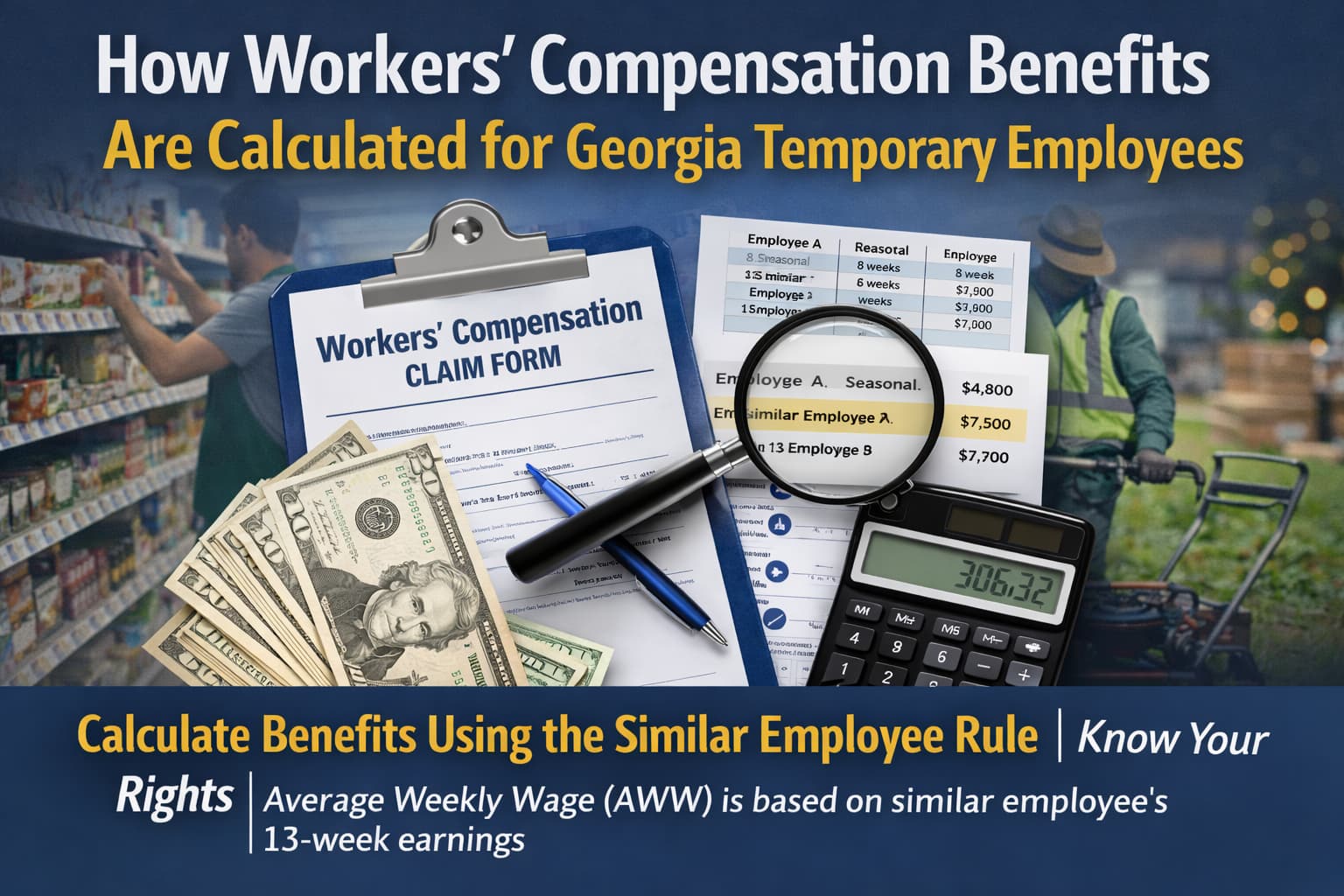
One of the most complex issues in a seasonal worker’s claim is the calculation of their weekly income benefits. These benefits are based on your Average Weekly Wage (AWW). Typically, the AWW is calculated by averaging your gross pay from the 13 weeks before your injury. But what happens if you were only hired for an eight-week summer job?
How the Similar Employee Rule Determines Average Weekly Wage in Georgia
Georgia law addresses this exact situation. Under O.C.G.A. § 34-9-260, if you have not worked for a substantial portion of the 13-week period, the state requires the insurance company to use the wages of a similar employee.
This means that, when the statutory criteria are met, the insurer must use the wages of a similar employee to calculate your AWW. An experienced Atlanta workers’ compensation attorney will know to demand this information from the insurer to prevent them from using an unfairly low wage to calculate your benefits.
Defenses Insurance Companies Use Against Seasonal Worker Claims
Insurance companies have a playbook of arguments they use to deny or limit claims filed by seasonal workers. A prepared legal team can anticipate and dismantle these arguments with evidence and a strong understanding of Georgia law.
Misclassification as an Independent Contractor
The most common defense is to claim you are not an employee at all. They might point to a contract you signed that calls you an independent contractor.
However, as discussed, a contract cannot override the legal reality of the employment relationship. Your Atlanta workers’ compensation attorney can fight this misclassification by showing the level of control the employer had over your work.
Additional Defenses Insurers Use to Challenge Seasonal Worker Injury Claims
Beyond misclassification, an adjuster might try other tactics to avoid paying your claim. They will look for any reason to suggest your injury is not the employer’s responsibility.
An insurer’s denial may be based on a number of arguments. It is the job of your Atlanta workers’ compensation attorney to refute these claims with factual evidence.
- The injury did not arise out of employment: They might argue your injury was due to a personal issue (an idiopathic fall) and not a workplace hazard.
- Violation of safety rules: They may claim you were injured because you engaged in horseplay or willfully violated a known safety rule.
- Intoxication: The law allows a denial if the injury was caused by intoxication from alcohol or drugs, a defense they must prove.
- Failure to report in time: If you miss the 30-day reporting deadline, they have a legal basis to deny the entire claim.
A skilled Atlanta workers’ compensation attorney can address these defenses using evidence and applicable law.
FAQs for an Atlanta Workers’ Compensation Attorneys
What if I was only working for the summer as a student?
If you were working only for the summer as a student, you can still qualify as an employee. Your student status does not change your eligibility, as long as your employer is subject to Georgia’s workers’ compensation laws. If you were injured while performing your job duties, you are covered under the law—whether you are a student, a part-time worker, or a full-time employee.
Does my employer have to have a certain number of employees to provide workers’ comp?
Yes. In Georgia, any business with three or more employees, including regular part-time and seasonal workers, is required to carry workers’ compensation insurance. The Georgia State Board of Workers’ Compensation enforces this rule.
Can my employer fire me for filing a workers’ compensation claim?
Georgia law prohibits employers from retaliating against employees for filing a workers’ compensation claim. If you believe you were fired for this reason, you may have grounds for a separate wrongful termination lawsuit.
What benefits am I eligible for as a seasonal worker?
If your claim is accepted, you are eligible for the same benefits as any other employee. This includes payment of all authorized medical bills, weekly income benefits while you are out of work, and benefits for any permanent partial disability resulting from the injury.
Protecting Your Rights After a Seasonal Work Injury in Georgia
Protect your rights as a seasonal worker. Even if your job is temporary, your protections are not. A workplace injury can cause long-term physical and financial strain, and Georgia law provides you the same rights as any other employee.
Do not let an insurance company pressure you or mislead you about your eligibility for benefits. You are allowed to challenge their decisions.
Take the next step toward getting the benefits you need. Contact the Atlanta workers’ compensation attorneys at Hasner Law for a free case review.
Call us today at 678-888-HURT (4878). Your consultation is confidential, and you owe nothing unless we win.