

Stephen Hasner | Product Liability, Workers' Compensation | January 8, 2026
When workplace machinery fails, the results can be catastrophic. Missing safety guards, malfunctioning switches, or defective components often lead to injuries that leave workers facing medical treatment, lost income, and growing financial strain. Georgia’s workers’ compensation system is your first line of support, offering medical care and wage benefits without requiring you to prove anyone was at fault.
But workers’ compensation may not be the end of the story. If a manufacturer, distributor, installer, or maintenance provider played a role in the equipment’s failure, you may have the right to pursue a separate third-party claim.
A third-party case can open the door to compensation that workers’ comp doesn’t cover—such as pain and suffering and the full value of your lost earnings. Because these claims run alongside your workers’ comp case, it’s crucial to have an attorney who understands how the two systems interact.
If faulty machinery injured you on the job, the attorneys at Hasner Law can help you explore every available path to recovery. Call 678-888-HURT (4878) for a free case review.
Key Takeaways on Injuries from Faulty Machinery
- Workers’ compensation is your primary claim against your employer after a machinery accident, and it is a no-fault system.
- You generally cannot sue your employer for a work injury, but you may be able to file a separate lawsuit against a negligent third party who contributed to the accident.
- Third parties can include the machine’s manufacturer, a maintenance company, an installer, or the distributor who sold the faulty equipment.
- A third-party lawsuit allows you to pursue damages not available in workers’ comp, such as compensation for pain and suffering.
- Successfully managing both a workers’ comp claim and a third-party lawsuit requires a skilled attorney who understands the complex interactions between the two legal systems.
Hasner Law: A Comprehensive Advocate for Your Injury Claim
When faulty machinery causes a work injury, it’s important to choose a law firm with broad experience. This includes both workers’ compensation knowledge and the skills of a trial lawyer who understands product liability and technical details.
At Hasner Law, our team brings extensive experience in workers’ compensation hearings and is fully prepared to handle civil trials in Fulton County Superior Court, providing clients with steady, capable representation every step of the way.
With more than 80 years of combined experience and over $1 billion recovered for injured Georgians, we know how to build a strong case. When we take on a defective machinery claim, we act quickly. We file your workers’ compensation claim to pursue treatment and wage benefits, while also investigating the equipment involved in your injury.
Working with engineers and industry specialists, we examine potential design problems, manufacturing defects, and maintenance issues. We are prepared to hold major companies and their insurers accountable in both the workers’ compensation system and in civil court.
Understanding Your Workers’ Compensation Claim
After any workplace injury, including one caused by faulty equipment, your primary source of benefits is the workers’ compensation system. Under the Official Code of Georgia Annotated (O.C.G.A.) Title 34, Chapter 9, this system provides specific benefits without you having to prove your employer was at fault.
The Exclusive Remedy Rule in Georgia Workers’ Compensation
Workers’ compensation is generally considered the exclusive remedy against your employer. This means that in exchange for providing no-fault benefits, your employer is shielded from being sued for negligence.
You cannot file a personal injury lawsuit against your boss or company, even if their failure to maintain the machine contributed to your injury. While this rule protects employers, it does not protect other outside parties who may have been negligent.
Identifying Negligent Third Parties in a Machinery Accident
Workers’ compensation laws generally protect only your direct employer. When another individual or company contributes to a machinery-related injury, that party does not receive the same legal protection.
They can be held responsible through a separate third-party personal injury claim. Determining who those parties are is an important part of a thorough case review, and an experienced Atlanta workers’ compensation attorney will work to identify every source of liability.
A thorough investigation may show that outside entities contributed to the equipment failure. If so, those parties can be held accountable through a separate claim. Examples include:
- The Machine Manufacturer: A company that designed or produced defective equipment may be liable for problems in the machine’s construction or design.
- An Independent Maintenance Provider: If an outside contractor was hired to inspect, service, or repair the machinery, that contractor must perform the work properly. Neglect in this area can support a claim.
- A Distributor or Seller: Businesses that supplied the machinery may be accountable if they passed along equipment with defects.
- An Installer or Assembler: A third party responsible for installation or setup may be liable if improper assembly contributed to the malfunction.
Bringing a claim against these parties does not interfere with your workers’ compensation benefits. It simply offers an additional path to pursue financial recovery for the harm you suffered.
Product Liability and Defective Machinery Claims
A third-party claim against a manufacturer is a type of product liability lawsuit. These cases argue that the machine was unreasonably dangerous when it left the manufacturer’s control.
Georgia law recognizes several types of defects that can make a product unsafe. An experienced Atlanta workers’ compensation lawyer will investigate all potential defects.
Design Defects in Dangerous or Faulty Machinery
A design defect means the machine was unsafe from the very beginning, even if it was built perfectly according to its specifications. The entire product line is inherently dangerous because of a flaw in the original design. An experienced attorney may hire an engineering expert to prove that a safer, economically feasible design alternative existed.
Manufacturing Defects That Lead to Machinery-Related Injuries
A manufacturing defect occurs when something goes wrong during the production process. The machine’s design may be safe, but the specific unit you were using was flawed due to an error at the factory. This could be the result of using substandard materials, incorrect assembly, or poor quality control.
The Occupational Safety and Health Administration (OSHA) has extensive regulations on machine guarding and safety devices. When these standards are not met due to a defect, it can be powerful evidence in a product liability case.
- Missing or inadequate safety guards.
- Defective wiring or electrical components.
- Emergency shut-off mechanisms that fail to work.
- Weak materials that crack or break under normal stress.
- Lack of warnings about foreseeable dangers.
Any of these defects can make an otherwise standard piece of equipment dangerously unsafe for workers.
Failure to Warn Claims in Defective Machinery Cases
A failure to warn claim, also known as a marketing defect, argues that the manufacturer did not provide adequate instructions or warnings about the machine’s potential dangers. The warnings must be clear, visible, and inform the user of non-obvious risks associated with the machine’s normal operation.
Understanding the Difference Between Workers’ Comp and a Third-Party Claim
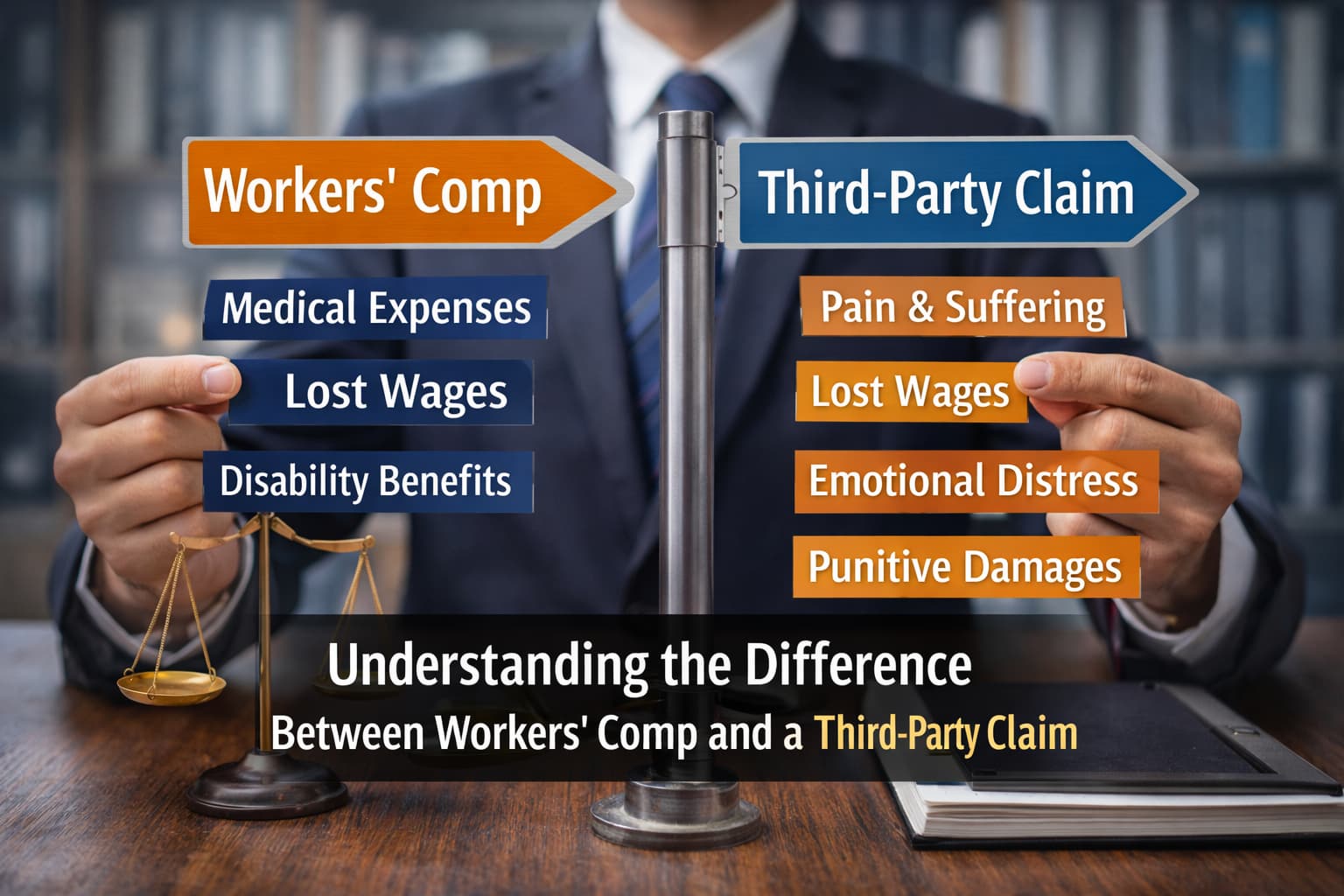
While your workers’ compensation claim is proceeding, your Atlanta workers’ compensation lawyer can file a separate personal injury lawsuit against the negligent third party.
These two cases proceed on parallel tracks, and the potential compensation is very different. Workers’ compensation provides specific, limited benefits. A third-party claim allows you to pursue the full range of damages available under personal injury law.
The damages you can seek in a third-party lawsuit are much more comprehensive than the benefits provided by workers’ comp. This is why exploring a third-party claim is so important.
- Medical expenses (past and future).
- Lost wages and diminished future earning capacity.
- Physical pain and suffering.
- Emotional distress and mental anguish.
- Punitive damages, in cases of extreme negligence.
Workers’ compensation does not cover pain and suffering, even though it is often a significant part of a serious injury claim.
Coordinating Your Workers’ Compensation and Third-Party Cases
Successfully navigating a workers’ comp claim and a third-party lawsuit at the same time is a complex legal balancing act. The insurance company in your workers’ comp case has a right to be reimbursed for the benefits they paid you if you win your third-party case.
This is called subrogation. An experienced attorney knows how to negotiate with the workers’ comp insurer to reduce the amount you have to pay back, helping you keep more of the money you recover.
Taking the right steps after your accident is vital to preserving your rights in both a workers’ comp and a potential third-party claim. Documentation and preservation of evidence are key.
- Preserve the Machine: Your employer should not repair, alter, or dispose of the machine that injured you. It is a critical piece of evidence.
- Take Photographs: Document the machine, the surrounding area, and your injuries.
- Identify Witnesses: Get the names and contact information of anyone who saw the accident.
- Keep Detailed Notes: Write down everything you remember about the accident and your conversations with your employer.
This evidence will be invaluable to your Atlanta workers’ compensation lawyer as they begin to investigate the third-party aspect of your claim.
FAQs About Third-Party Machinery Injury Claims
Can I have a third-party claim if my own employer’s poor maintenance caused the accident?
Generally, no. The exclusive remedy rule protects your employer from lawsuits related to negligence, including poor maintenance. A third-party claim is only possible if an outside entity, separate from your employer, was at fault.
How long do I have to file a third-party lawsuit in Georgia?
In Georgia, the statute of limitations for personal injury claims is typically two years from the date of the injury. This is a strict deadline. It is important to contact an attorney quickly to ensure your right to file a lawsuit is preserved.
What if the machine that hurt me was very old?
The age of the machine can be a factor, but it does not automatically prevent a product liability claim. An investigation might reveal that the manufacturer was aware of a defect for many years and failed to issue a recall, or that a recent modification by a third party made the machine unsafe.
Will my workers’ comp benefits stop if I file a third-party lawsuit?
No. Your eligibility for workers’ compensation benefits is independent of your third-party claim. You can continue to receive your medical and wage benefits while your personal injury lawsuit is pending.
Why do I have to pay back the workers’ comp insurer from my third-party settlement?
This happens because of a rule called subrogation, which prevents you from getting paid twice for the same expenses. If workers’ compensation paid your medical bills and lost wages, the insurance company can ask to be paid back from any money you get from the third party that caused your injury. Still, a skilled Atlanta workers’ compensation attorney can often negotiate to lower the amount you have to repay, allowing you to keep more of your settlement.
Seeking Full Recovery After a Machinery Injury
When a serious machinery malfunction leaves you injured, it is important to work with a law firm that understands every aspect of your situation. Depending only on workers’ compensation may cover only part of what you need to move forward.
A well-built third-party claim can offer financial support beyond what workers’ compensation provides. These cases often involve multiple parties and require an attorney who has the skill and resources to pursue both types of claims at the same time.
Make sure every potential source of compensation is explored. The attorneys at Hasner Law are prepared to examine your case from all angles and pursue every available path.
Contact our team today to learn more by calling 678-888-HURT (4878) for a free consultation with an Atlanta workers’ compensation lawyer.