

Stephen Hasner | Workers' Compensation | January 12, 2026
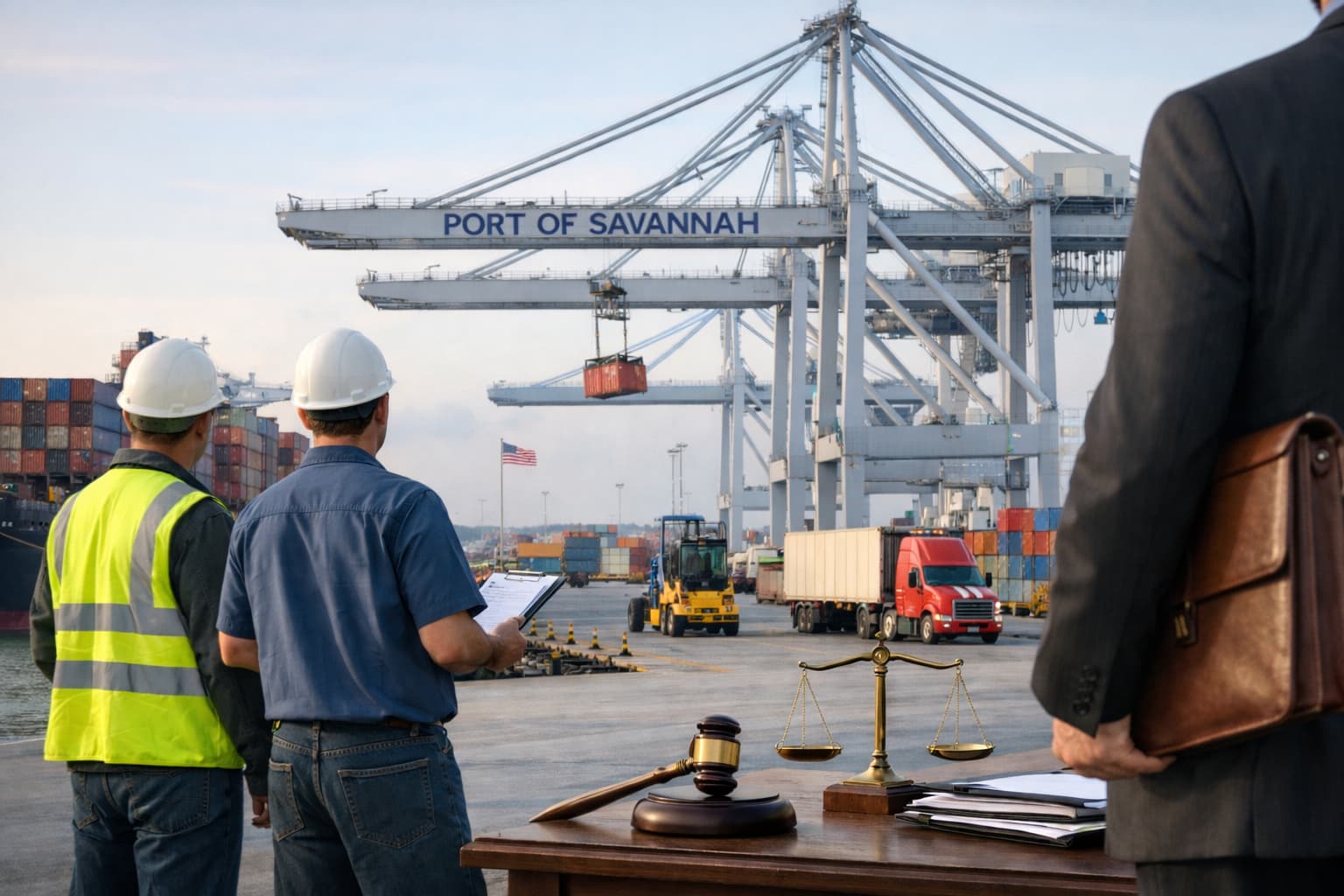
The Port of Savannah is one of the busiest hubs on the East Coast, and its fast-paced environment exposes workers to significant risks. Heavy machinery, crowded docks, and constant cargo movement create conditions where accidents can cause severe, career-disrupting injuries.
When a port worker is hurt, the claims process can be difficult to navigate because both state and federal laws may apply. Choosing the correct system is key to securing the benefits you’re entitled to. A Savannah workers’ compensation lawyer familiar with both Georgia workers’ comp and the LHWCA can help you move your claim forward.
If you were injured while working at the Port of Savannah, you don’t have to face the process alone. Contact Hasner Law for a free, confidential case review. Call our Savannah office at (912) 234-2334 today.
Key Takeaways for Injured Port Workers in Savannah
- Depending on your specific job duties and where you were hurt, an injury at the Port of Savannah may fall under the Georgia Workers’ Compensation Act or the federal Longshore and Harbor Workers’ Compensation Act (LHWCA).
- The specific location and nature of your work determine which law applies, a critical distinction that significantly impacts your benefits.
- Port workers face a high risk of severe injuries due to heavy machinery, container operations, and constant vehicle traffic.
- In addition to workers’ comp, you may have a third-party personal injury claim if your injury was caused by the negligence of an outside company or contractor.
- A Savannah workers’ compensation lawyer with experience in both state and federal laws is vital to protecting your rights and maximizing your recovery.
The Unique Dangers of Working at the Port of Savannah
The Port of Savannah is a high-stakes environment where immense power and weight are in constant motion. The Georgia Ports Authority operates a world-class facility, but the inherent nature of the work creates significant risks for longshoremen, crane operators, truck drivers, and all support personnel.
The fast pace required to load and unload vessels on tight schedules can sometimes lead to safety oversights.
Common Hazards for Port Employees
Port operations involve heavy equipment and constant movement, creating conditions where serious injuries can occur. An experienced Savannah workers’ compensation lawyer is familiar with the causes of these serious incidents.
Workers at the port are exposed daily to a variety of high-risk situations. Constant vigilance is required, but even the most careful employee can be injured by factors outside their control.
- Heavy machinery and crane operations.
- Container loading, unloading, and stacking.
- Congested traffic from trucks and yard mules.
- Slip and fall hazards from spills or weather.
- Exposure to hazardous materials.
These hazards can lead to life-altering injuries that require extensive medical care and may prevent you from ever returning to the physically demanding work of the port.
Which Law Applies to Your Savannah Port Injury: Georgia Workers’ Comp vs. LHWCA
One of the more challenging parts of a port injury claim is identifying which law governs the case. Your claim will generally fall under either the Georgia Workers’ Compensation Act or the federal Longshore and Harbor Workers’ Compensation Act (LHWCA).
The distinction matters because each system offers different benefits and follows different procedures. Filing under the wrong system can cause significant delays and may require you to restart or refile your claim in the correct forum.
Georgia Workers’ Compensation Act Coverage for Land-Based Port Employees
The Georgia Workers’ Compensation Act covers most land-based employees in the state. If your job does not regularly involve maritime activities or work on or near navigable waters, your claim will more likely be governed by Georgia workers’ compensation law.
For example, an administrative worker in an office building located on port property would likely fall under the state system. This is a no-fault system that provides medical, income, and disability benefits. Your claim would be filed with the Georgia State Board of Workers’ Compensation.
The Longshore and Harbor Workers’ Compensation Act (LHWCA)
The LHWCA is a federal law that protects maritime workers who aren’t classified as traditional seamen but are hurt on or near navigable waters. This includes many dockworkers, shipbuilders, and harbor construction workers. The U.S. Department of Labor oversees and administers the Act.
Whether the LHWCA applies to your claim depends on two main factors: where the injury occurred and the type of work you were performing. Both your location and your job duties are evaluated when determining coverage.
- Status Test: Your job duties must involve covered maritime employment, such as loading, unloading, building, repairing, or similar work on vessels or their cargo. This could include a mechanic who services the ship-to-shore cranes or a checker who tallies cargo.
- Situs Test: The injury must occur on navigable waters or in adjoining areas, such as docks, piers, terminals, wharves, and similar locations customarily used for loading, unloading, or other maritime activities. Courts have interpreted this to include areas like container yards and gear lockers.
A Savannah workers’ compensation lawyer with experience in this area is needed to perform this complex legal analysis.
How Jurisdiction Affects Your Workers’ Compensation Benefits
The law that applies to your claim can significantly influence the benefits available to you. In many cases, the LHWCA provides a higher weekly compensation rate than Georgia’s state system, depending on your average weekly wage and the statutory maximums involved.
At the same time, the LHWCA follows its own filing and dispute-resolution procedures, which can be more involved than the state process. The points below outline some of the main differences.
A knowledgeable Savannah workers’ compensation lawyer can explain how these details relate to your situation.
- Higher weekly benefits: The LHWCA’s federal maximum often results in a larger weekly payment.
- Choice of doctor: The LHWCA allows you to select your own treating physician.
- Federal oversight: Claims are handled by the U.S. Department of Labor rather than Georgia’s state system.
- Different disability calculations: The approach to evaluating and awarding permanent disability varies.
Filing under the wrong system can lead to delays or even a complete denial of your claim, so it’s important to determine the correct path at the start.
Identifying Third-Party Liability in Port Accidents
While workers’ compensation is generally your exclusive remedy against your employer, it does not prevent you from pursuing a separate negligence claim against a responsible third party. The port is a busy environment with many different companies working in close proximity.
If your injury was caused by the carelessness of another company’s employee or a defective piece of equipment, you may have a separate personal injury lawsuit.
Examples of Third Parties Who May Be Responsible for a Port Injury
An experienced Savannah workers’ compensation lawyer will investigate your accident to identify any and all potential sources of recovery. This goes beyond just your employer.
Many entities operate at the port, and any of them could be responsible for your injury. A thorough investigation may reveal negligence on the part of various parties.
- An independent trucking company whose driver caused a collision.
- The manufacturer of a defective crane or forklift that malfunctioned.
- A third-party maintenance company that failed to properly service equipment.
- The owner of a vessel whose crew created a hazardous condition.
- A contractor working on port property who left debris in a walkway.
A third‑party personal injury claim may allow you to seek damages such as pain and suffering that are not available through workers’ compensation benefits.
What to Do After an Injury at the Port of Savannah
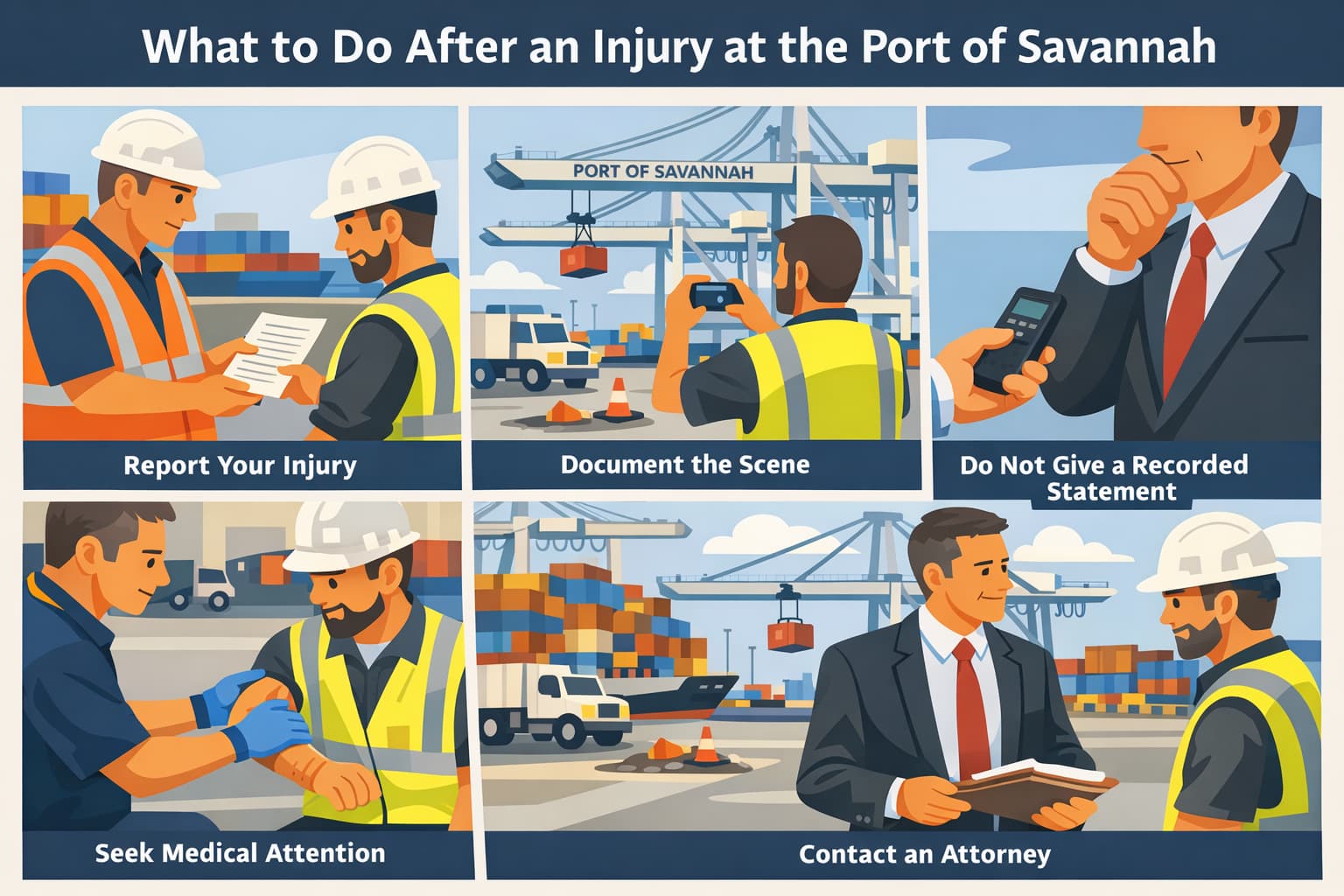
The actions you take immediately after an accident can protect your health and your legal rights. It is vital to document the incident and get proper medical care.
Following a clear procedure can strengthen your claim. An attorney can guide you through dispute resolution processes like workers’ compensation mediation if your claim is denied.
- Report Your Injury: Notify your supervisor immediately, in writing. This creates an official record of the incident.
- Seek Medical Attention: Get a medical evaluation right away to diagnose your injuries and link them to the accident.
- Document the Scene: Take photos and get witness contact information. Conditions at a port change quickly.
- Do Not Give a Recorded Statement: Do not speak to any insurance adjuster without a lawyer present to protect you.
- Contact an Attorney: Consult with a Savannah workers’ compensation lawyer as soon as possible to preserve evidence and protect your rights.
These steps help create a clear record of what happened and strengthen your position during the claims process.
Why Injured Port Workers Need a Savannah Workers’ Compensation Lawyer
If you are hurt while working at the Port of Savannah, you are not only dealing with an insurance company; you are also working through a complicated legal process. Hasner Law is prepared to take on that challenge.
Our practice is grounded in thorough litigation and a strong command of the laws that protect Georgia workers, including those at the port.
Our firm focuses on thorough case preparation rather than processing a high volume of quick settlements. We prepare every case as if it will proceed to trial, which strengthens your position from the start.
Our team brings more than 80 years of combined legal experience and has recovered substantial compensation for injured clients. We understand the hazards involved in port work and the specific legal issues these claims present.
We review the facts of your injury, identify the proper legal system for your claim, and evaluate any third-party involvement. When you hire a Savannah workers’ compensation lawyer from our firm, you receive committed representation that addresses every legal step.
This includes obtaining machinery maintenance records, speaking with eyewitnesses, and consulting with maritime safety professionals. With these tasks handled, you can focus on your physical and emotional wellbeing.
FAQs for Savannah Workers’ Compensation Lawyers
What if I am an independent truck driver injured at the port?
Your case can be very complex. While you may not have a workers’ comp claim against your own company, you may have a personal injury claim against the port authority or another company whose negligence caused your injury.
Am I covered by the Jones Act?
The Jones Act covers seamen who are members of a vessel’s crew. Most land-based port workers are covered by the LHWCA or state workers’ comp, not the Jones Act. An attorney can determine your correct classification.
What is the deadline for filing a claim?
Under Georgia’s workers’ compensation law, you generally have one year to file a claim, with the exact timeline depending on when the period begins and whether medical treatment or benefit payments extend it.
The LHWCA also provides a one-year filing window, usually starting when you realize your injury is related to your work. Taking action promptly helps preserve evidence and supports your ability to pursue benefits.
Can I choose my own doctor?
Under the LHWCA, you have the right to choose your own physician. Under Georgia’s state system, you are generally required to select a doctor from a panel provided by your employer. This is a significant difference between the two systems.
What if multiple companies are at fault for my accident?
This is a common scenario in a busy environment like a port. Your attorney can file claims against all negligent parties. Georgia’s laws on apportionment will apply, meaning a jury may assign a percentage of fault to each defendant.
Speak With a Savannah Workers’ Compensation Lawyer Today
An injury at the Port of Savannah can threaten your health, your future earning ability, and your family’s financial stability. You do not have to face this process alone. The laws that apply to port injuries can be difficult to navigate, and having a lawyer who understands this area of practice gives you a stronger foundation for moving forward.
Do not wait for an insurance company to push back on your claim. Take the next step toward protecting your future. Contact the dedicated Savannah workers’ compensation team at Hasner Law. We will pursue every benefit and form of compensation available to you under state or federal law.
Call our Savannah office at (912) 234-2334 for a free, confidential consultation. You pay no attorney’s fees unless we obtain a recovery for you, in accordance with ethics rules and any required fee approvals in workers’ compensation cases.