

Rankings.io | Car Accidents, Personal Injury | January 26, 2026

A rear-end collision can occur with no warning. These crashes are common on the Downtown Connector and major interstates, but determining who is legally responsible is not always simple. Georgia law begins with a presumption that the rear driver is at fault, yet insurers may challenge that presumption and attempt to shift responsibility onto the injured person.
Fault is ultimately a legal question, not something the insurance company gets to decide. An Atlanta rear-end collision car accident lawyer can examine the facts, gather evidence, and present a clear account of how the crash occurred when liability is disputed.
You do not have to manage this process on your own. If you were injured in a rear-end crash, the attorneys at Hasner Law are available to review your situation and discuss your options. Call 678-888-HURT (4878) for a free case evaluation.
Key Takeaways for Your Atlanta Rear-End Collision Claim
- In Georgia, there is a legal presumption that the driver who rear-ends another vehicle is at fault, but this presumption can be challenged.
- The lead driver may be found partially or fully at fault if they were negligent, such as by braking suddenly for no reason or having broken taillights.
- Physical evidence, witness testimony, and video footage are all important for proving which driver was truly responsible for the collision.
- Georgia’s comparative negligence law allows for fault to be shared, and your ability to recover damages depends on your percentage of fault.
- An Atlanta rear-end collision car accident lawyer is needed for conducting a thorough investigation and fighting back when an insurer tries to unfairly shift blame to you.
Why Georgia Law Presumes the Rear Driver Is at Fault
In most rear-end accidents, the law generally assumes that the driver in the back is at fault. This idea is not just common sense but a legal rule based on the standards of safe driving. Georgia law clearly requires drivers to keep a safe distance from the vehicles in front of them.
Georgia’s Following Too Closely Law
The governing statute for these situations is O.C.G.A. § 40-6-49, which requires drivers to maintain a reasonable and prudent distance behind the vehicle ahead.
The statute directs motorists to consider factors such as traffic density, vehicle speed, and existing roadway or weather conditions when determining an appropriate following distance. In short, drivers must leave enough space to react safely to whatever the vehicle in front of them may do.
Georgia law places a clear duty on each motorist to ensure they can slow or stop without causing a collision if the lead vehicle reduces speed or brakes suddenly. When a rear-end crash occurs, this duty becomes central to determining fault.
The driver who strikes the rear of another vehicle is generally presumed to have failed to maintain the legally required safe distance. That failure is treated as a violation of the statute and often serves as the foundation for establishing the trailing driver’s liability in civil claims arising from the collision.
Can the Lead Driver Be at Fault in a Rear-End Accident?
The law usually assumes the driver in the back is at fault, but this is not always true. An insurance company will look for anything that shows the front driver was careless and helped cause the crash. If they can put even part of the blame on you, they can lower or even avoid the amount they have to pay.
Exceptions to the Rule When the Front Car Is Negligent
Sometimes the driver in front may be partly or fully responsible for a rear-end collision. An experienced Atlanta rear-end accident attorney will review the facts to determine whether any exceptions apply.
In some cases, the front driver’s actions can overturn the usual assumption that the rear driver is at fault. These actions can create a sudden and unexpected hazard for the driver following behind.
- Braking Suddenly and Without Reason: This is often called brake checking. If a driver slams on their brakes in an act of road rage or for no legitimate reason, they may be held liable.
- Reversing into Traffic: A driver who is backing out of a parking space or driveway and reverses into the path of an oncoming car can be at fault.
- Driving with Broken Brake Lights: A driver has a duty to maintain their vehicle. If their brake lights are out, a trailing driver has no warning that they are stopping.
- Making an Unsafe Lane Change: If a driver cuts off another car and immediately slows down or stops, they can be responsible for the resulting collision.
- Stopping Abruptly to Make a Turn: A driver who stops unexpectedly in a travel lane to make a turn without proper signaling may be negligent.
Proving that one of these situations occurred takes more than your own account—you need an investigation that uncovers solid, objective evidence.
How an Atlanta Car Accident Lawyer Proves Fault in a Rear-End Crash
Because fault can be disputed, gathering evidence immediately following the accident is an important part of building a strong claim. The insurance company for the other driver will have its investigators working on the case right away. You need a legal team doing the same for you.
Important Evidence for Your Rear-End Collision Case
Your attorney will work to collect and preserve all evidence that can help reconstruct the accident and prove the other driver’s negligence. This evidence tells the story of what really happened.
A strong case is built on a foundation of solid proof. Your lawyer will seek out all available evidence to support your claim.
- The Official Police Report: The officer’s initial assessment and any citations issued can be powerful information.
- Witness Statements: Independent witnesses who saw the crash can provide objective testimony about the actions of both drivers.
- Dashcam and Surveillance Footage: Video from dashcams, nearby businesses, or traffic cameras can provide undeniable proof of how the accident occurred.
- Vehicle Damage Analysis: The location and severity of the damage to both cars can help an accident reconstruction expert determine the forces involved.
- Cell Phone Records: If distracted driving is suspected, your attorney can subpoena the other driver’s phone records.
This evidence is necessary for fighting back when an insurance adjuster tries to blame you for the crash.
How Georgia’s Comparative Negligence Law Affects Your Settlement
In many car accidents, the reality is that both drivers may share some degree of fault. Georgia law has a specific system for handling these situations. This is known as the modified comparative negligence rule.
Understanding Georgia’s 50 Percent Fault Bar to Recovery
Under O.C.G.A. § 51-12-33, an injured person may recover damages as long as they are found to be less than 50 percent at fault for the accident. If a jury concludes that you are 50 percent or more responsible, you cannot recover compensation. When your share of fault is below 50 percent, any award you receive is reduced according to your percentage of responsibility.
This comparative negligence rule applies to most personal injury cases in Georgia, including car accidents and many other types of claims. One exception involves workplace slip-and-fall injuries, which fall under the no-fault workers’ compensation system.
If a third party contributed to the workplace accident, you may be able to bring a separate personal injury claim against that party, where comparative negligence would again apply. This shows that the rules can shift depending on the type of incident and who was involved.
Serious Injuries Caused by Rear-End Collisions
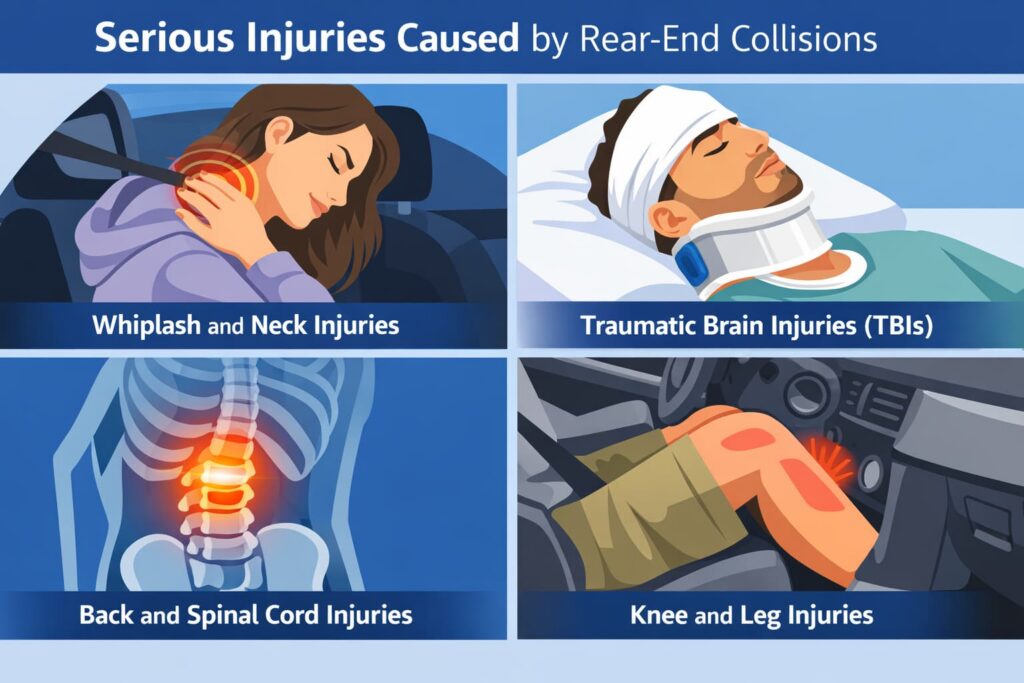
Even a low-speed rear-end collision can generate a significant amount of force, leading to serious and painful injuries. The unexpected nature of the impact gives the occupants of the lead car no time to brace themselves.
The forces in a rear-end crash can cause a variety of debilitating injuries. These conditions often require extensive medical treatment and can affect your life for years to come.
- Whiplash and Neck Injuries: This is the most common injury, caused by the violent back-and-forth motion of the head. It can damage the soft tissues, nerves, and discs in the neck.
- Back and Spinal Cord Injuries: The impact can cause herniated discs, fractured vertebrae, or other serious back injuries.
- Traumatic Brain Injuries (TBIs): The brain can be thrown against the inside of the skull, causing a concussion or a more severe TBI.
- Knee and Leg Injuries: A driver’s knees can be slammed into the dashboard, causing fractures or ligament damage.
These injuries can lead to chronic pain and disability, making it important to secure a recovery that accounts for all your future medical needs.
FAQs for an Atlanta Rear-End Collision Car Accident Lawyer
What if the other driver’s insurance company is already blaming me for the crash?
This is a common strategy insurers use to limit what they might have to pay. Do not argue with the adjuster, and do not agree to give a recorded statement. Simply decline to discuss the accident any further and contact an Atlanta rear-end collision attorney as soon as possible. Once you have legal representation, your lawyer will handle all communication with the insurance company and make sure your rights are protected.
The damage to my car does not look that bad. Can I still be seriously injured?
Yes. Even when a vehicle shows only minor damage, the occupants can experience significant injuries. Modern cars are built to absorb impact and protect the frame, which means the exterior may not show much force.
However, that energy still travels through the vehicle and into the people inside. It is common for rear-end crashes to cause whiplash, herniated discs, and other spinal injuries, even at low speeds.
What is the most important thing to do after a rear-end accident?
After ensuring everyone is safe and calling 911, the next critical step is to get a medical evaluation right away. Many injuries from rear-end crashes do not show symptoms immediately. Seeing a doctor creates documentation connecting your injuries to the accident, which is essential evidence if you pursue a claim later.
Will my case go to trial?
Most car accident cases settle long before reaching a courtroom. However, the insurance company’s approach often changes when you have a lawyer who is fully prepared to go to trial if necessary. When insurers know your attorney is willing and able to present your case to a jury, they are more likely to offer a fair settlement.
How long do I have to file a lawsuit in Georgia?
In Georgia, you generally have two years from the date of the accident to file a personal injury lawsuit. This is a strict legal deadline. Missing it can prevent you from recovering compensation, so it is important to speak with an attorney as early as possible to protect your claim.
Contact an Atlanta Rear-End Collision Car Accident Lawyer Today
Do not accept an insurance company’s self-serving determination of fault. The law is more nuanced than they want you to believe, and you have the right to an independent investigation and a powerful legal advocate. An accident can leave you feeling powerless, but taking the step to hire an attorney is an act of taking back control.
The moments following a rear-end collision are confusing, but your next step is clear. Contact the dedicated and trial-ready Atlanta personal injury lawyer team at Hasner Law.
We will fight to prove the other driver’s fault and work to pursue the full and fair compensation available under the law. Call us today at 678-888-HURT (4878) for your free consultation.