
Atlanta Burn Injury Lawyer
Burn treatment does not end when you leave the hospital. It stretches across months and sometimes years of skin grafts, scar revisions, compression therapy, and counseling. The insurance company offering you a settlement right now has no interest in paying for any of that.
An Atlanta burn injury lawyer at Hasner Law builds your claim around the full cost of recovery, not just the bills sitting on your counter today.
We represent burn victims across Fulton, DeKalb, Cobb, and Gwinnett counties in claims involving workplace accidents, defective products, vehicle fires, and dangerous property conditions.
Call (678) 888-4878 to talk through your options at no cost.
How Does Hasner Law Handle a Georgia Burn Injury Claim?
Burn injury claims demand a different approach than a typical personal injury case because the medical evidence is more detailed and the damages extend years into the future.
Our attorneys work alongside burn care professionals and life care planners to document every stage of your treatment and project costs the insurance company wants to ignore.
Medical Documentation and Future Cost Projections
Senior Attorney Judy Blackwell has practiced personal injury law in Georgia since 1984 and served six years as an Administrative Law Judge with the State Board of Workers’ Compensation. She understands how insurers minimize long-term injury claims.
Managing Partner Stephen Hasner, who co-founded the Georgia Injured Workers’ Advocates (GIWA), brings a defense-side background that reveals exactly how insurance companies build their strategies against burn victims.
Our attorneys coordinate with your burn surgeons, physical therapists, and mental health providers to build a medical narrative that accounts for treatment you have already received and procedures you may still need.
We also retain life care planners who calculate the projected lifetime cost of ongoing care, adaptive equipment, and lost earning capacity.
Contingency Fee Representation
Every burn injury case at Hasner Law operates on a contingency fee basis. You pay no attorney fees unless we recover compensation for you, and your first consultation is free.
What Types of Burns Lead to Legal Claims in Atlanta?
Burns are classified by depth, and the severity directly affects both your medical needs and the potential value of a legal claim.
Georgia burn injury cases most commonly involve thermal, chemical, and electrical burns caused by someone else’s negligence.
The classification system works as follows:
| Burn Classification | Depth of Damage | Typical Treatment | Legal Claim Impact |
| First-degree | Outer skin layer only | Topical treatment, pain management | Lower medical costs, but still compensable if caused by negligence |
| Second-degree | Deeper skin layers | Professional wound care, possible skin grafts for deep partial-thickness burns | Moderate to significant medical costs, potential scarring claims |
| Third-degree | Full thickness of skin and tissue beneath | Skin grafts, surgery, extended rehabilitation | High medical costs, strong claims for pain, suffering, and disfigurement |
| Fourth-degree | Through skin into muscle, tendon, or bone | Amputation, reconstructive surgery, lifelong care | Highest damages, often includes permanent disability and lost earning capacity |
An Atlanta third-degree burn lawyer at Hasner Law treats every classification seriously. Even burns that appear moderate at first may produce complications, infections, or scarring that affects your daily life and your ability to work.
What Causes Burn Injuries That Lead to Atlanta Personal Injury Claims?
Burn injuries in Atlanta arise from a range of preventable situations where another party’s negligence created a dangerous condition. The cause of the burn determines which parties may be liable and what type of claim applies.
Vehicle Accidents and Fuel Fires

Car, truck, and motorcycle crashes sometimes rupture fuel lines or ignite flammable materials on impact. Burns from vehicle fires on I-285, I-85, or along busy corridors like Peachtree Street may support a personal injury claim against the at-fault driver.
If a vehicle defect contributed to the fire, a product liability claim against the manufacturer may also apply.
Defective Products and Appliances
Lithium-ion batteries, space heaters, power tools, pressure cookers, and electrical appliances may cause burn injuries when they malfunction due to design flaws or manufacturing defects.
Georgia’s product liability statute under O.C.G.A. § 51-1-11 allows injured consumers to pursue claims against manufacturers, distributors, and retailers.
Dangerous Property Conditions
Faulty electrical wiring, exposed hot surfaces, chemical storage violations, and fire code deficiencies at apartment buildings, hotels, restaurants, or commercial properties in Atlanta may give rise to a premises liability claim.
Property owners owe a duty of care to visitors under O.C.G.A. § 51-3-1, and a failure to maintain safe conditions may make them liable for your burn injuries.
How Do Workplace Burn Injuries Work Differently in Georgia?
Workplace burn injuries in Atlanta may involve both a workers’ compensation claim and a separate personal injury claim against a third party.

Workers’ compensation covers medical bills and a portion of lost wages regardless of fault. A third-party claim may allow you to pursue full compensation for pain, suffering, scarring, and total lost income.
Workers at manufacturing plants, warehouses, construction sites, restaurant kitchens, and industrial facilities across metro Atlanta face daily burn hazards. Georgia’s workers’ compensation system under O.C.G.A. Title 34, Chapter 9 governs these claims.
Third-party liability may apply when the burn resulted from a situation beyond the employer’s direct control. Common third-party scenarios in Atlanta workplace burn cases include:
- A defective piece of machinery or equipment manufactured by an outside company
- An electrical system failure caused by a contractor’s faulty installation or repair
- A chemical burn caused by a product with inadequate safety warnings or labeling
- A building fire triggered by a property owner’s failure to meet fire code requirements
Hasner Law handles both workers’ compensation and third-party burn injury claims. We identify every available path to recovery so that no source of compensation goes unpursued.
Call (678) 888-4878 to discuss a workplace burn injury.
What Compensation May Be Available After a Burn Injury in Georgia?
Georgia’s modified comparative negligence rule under O.C.G.A. § 51-12-33 allows you to recover damages as long as your share of fault stays below 50%.
Burn injury claims frequently involve higher compensation than other personal injury cases because the treatment costs are extensive and the physical and emotional harm lasts far longer.

An Atlanta burn injury attorney at Hasner Law pursues compensation across every category your case supports:
- Past and future medical expenses, including emergency care, burn unit hospitalization, skin grafts, reconstructive surgery, wound care, physical therapy, and mental health counseling
- Lost wages from time away from work, plus diminished earning capacity if your burns limit your ability to perform your previous job
- Pain, suffering, emotional distress, disfigurement, and the lasting impact of visible scarring on your personal and professional life
- Costs of compression garments, scar revision procedures, adaptive equipment, and home modifications
Georgia law also permits punitive damages when the responsible party acted with extreme recklessness or willful disregard for safety.
A landlord who knowingly ignored fire code violations or a manufacturer that concealed a known defect may face punitive liability on top of compensatory damages.
Georgia gives you two years from the date of the burn injury to file a personal injury lawsuit under O.C.G.A. § 9-3-33.
Ask Hasner Law
Do burn injury cases take longer to settle than other personal injury claims?
Generally yes. Burn injury cases take longer because treatment often continues for months or years after the initial injury.
Settling too early risks undervaluing future surgeries, scar revisions, and therapy. Hasner Law monitors your treatment progress and files your claim at the point that best captures the full scope of your losses.
What if my burn injury left permanent scars?
Scarring and disfigurement are separate categories of compensable harm under Georgia law.
Your compensation may reflect the physical appearance of the scars, their location on your body, the emotional distress they cause, and any effect on your earning capacity or daily activities.
Medical photography and testimony from your treating physicians help document these damages.
My employer says workers’ comp covers everything. Is that true?
Not necessarily. Workers’ compensation covers medical bills and partial lost wages, but it does not compensate you for pain, suffering, or full income loss.
If a third party like an equipment manufacturer, building owner, or contractor contributed to your burn, you may have a separate personal injury claim that covers what workers’ comp leaves out.
FAQs for Atlanta Burn Injury Lawyer
Do I need a medical expert to file a burn injury lawsuit in Georgia?
Generally yes. Burn injury cases in Georgia typically require testimony from medical professionals who document the severity of the burn, the treatment plan, and the projected cost of future care.
Life care planners and burn surgeons often provide this testimony. Your attorney at Hasner Law coordinates with these professionals as part of building your claim.
How does the degree of a burn affect compensation?
More severe burns generally produce higher compensation because they require more extensive treatment, longer recovery, and greater impact on daily life.
A third-degree or fourth-degree burn that requires skin grafts, multiple surgeries, and years of rehabilitation generates larger medical costs and stronger claims for pain, suffering, and lost earning capacity than a first-degree burn.
What is the statute of limitations for a burn injury in Georgia?
Georgia law gives you two years from the date of the burn injury to file a personal injury lawsuit under O.C.G.A. § 9-3-33. If a defective product caused the burn, the product liability statute of limitations may apply instead.
For workplace burns, the workers’ compensation filing deadline runs on a separate timeline. Speaking with an attorney early protects all of your deadlines.
What if my burn injury happened at a rented apartment in Atlanta?
Your landlord may be liable if they failed to maintain safe conditions in the building. Faulty wiring, missing smoke detectors, blocked fire exits, and fire code violations are all conditions that may support a premises liability claim.
Hasner Law reviews your lease, the building’s inspection history, and any prior complaints to determine whether the landlord had notice of the hazard.
How much does it cost to hire an Atlanta burn injury lawyer?
Hasner Law handles every burn injury case on a contingency fee basis. You pay nothing upfront and owe no fees unless we recover compensation. Your initial consultation is free.
Get Clarity on Your Atlanta Burn Injury Claim

Your medical bills are growing. Your treatment timeline is unclear. The insurance adjuster offering a quick settlement has no obligation to tell you what your claim is actually worth.
An Atlanta burn injury lawyer at Hasner Law reviews your medical records, calculates projected future costs, and gives you a clear picture of what your claim may be worth before you make any decisions.
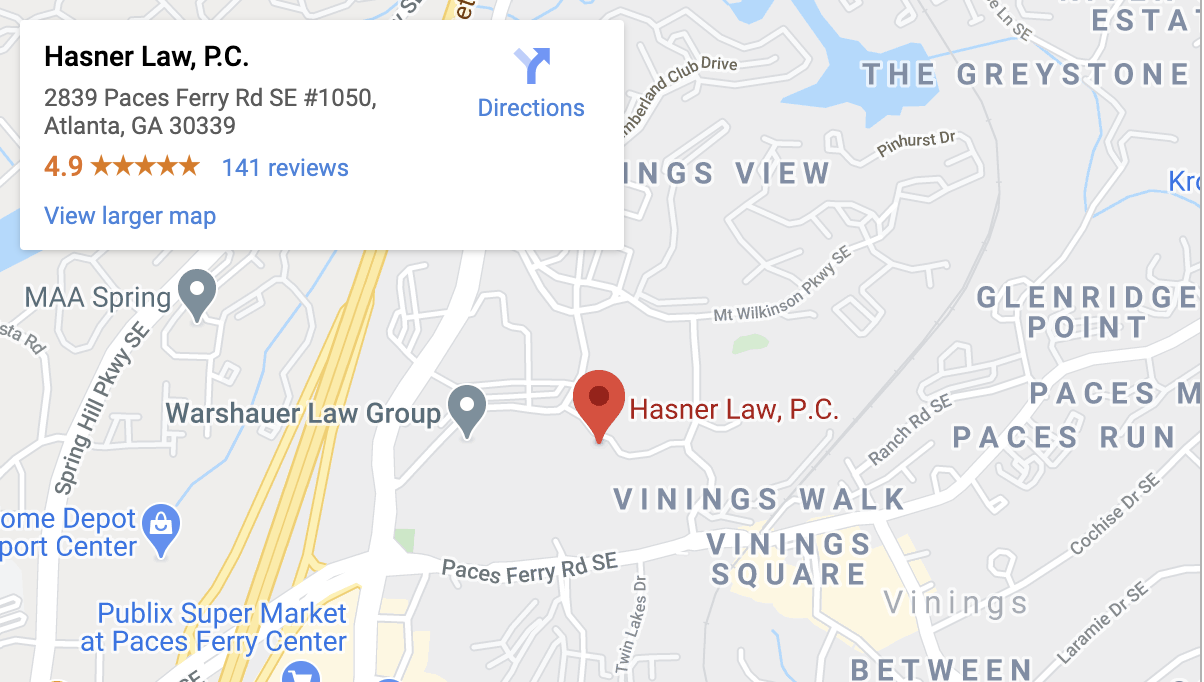
Our attorneys on Paces Ferry Road have handled burn claims involving workplace accidents, defective products, vehicle fires, and property owner negligence across Fulton County and throughout metro Atlanta.
Call (678) 888-4878 to get answers about your burn injury case. The consultation is free, and you owe nothing unless we win.
Hasner Law Injury & Workers’ Compensation Attorneys – Atlanta Office
275 Interstate N Circle SE #251,
Atlanta, GA 30339
P: 678-888-4878