

Stephen Hasner | Workers' Compensation | January 6, 2026

Repetitive stress injuries, including carpal tunnel syndrome, tendonitis, and ongoing back or shoulder pain, affect thousands of Georgia workers each year. Because these conditions develop slowly, insurers often deny claims. Cashiers, nurses, warehouse employees, and factory workers commonly face repeated strain that leads to significant injuries that interfere with their ability to work.
When an insurer questions whether your condition is job-related, an experienced Atlanta workers’ compensation attorney can help establish the evidence needed to validate your claim. If you’re living with ongoing pain you believe stems from your job duties, contact Hasner Law at 678-888-HURT (4878) for a free consultation.
Key Takeaways on Georgia Repetitive Stress Injury Workers Comp Claims
- Repetitive stress injuries may qualify for full workers’ compensation benefits under Georgia law when work activities are shown to substantially contribute to the condition.
- Documentation timing matters since gradual onset injuries lack specific accident dates that insurers use to deny claims.
- Medical evidence linking specific job duties to diagnosed conditions overcomes insurance company arguments about non-work causes.
- Georgia’s 30-day reporting requirement generally depends on when the injury reasonably becomes apparent as work-related, which in gradual-onset cases can differ from the first appearance of symptoms.
- Early intervention and proper documentation dramatically improve claim success rates for repetitive stress injuries.
Why Atlanta Workers Need Hasner Law for Repetitive Stress Injury Claims
Hasner Law recognizes that repetitive stress injuries can impact Georgia workers just as seriously as sudden workplace accidents and often require focused legal representation to secure available benefits.
Our Atlanta workers’ compensation lawyers have obtained substantial recoveries for injured workers, including those whose careers were affected by repetitive tasks such as scanning groceries, typing reports, or lifting patients over long periods.
We understand the distinct challenges posed by gradual-onset injuries and know how to build strong, evidence-based cases that hold insurers accountable under Georgia workers’ compensation law.
A repetitive stress injury can jeopardize your ability to work and support your family, making it critical to seek timely legal guidance before insurers develop grounds to dispute your claim. Immediate legal intervention helps protect your rights and counter the denial strategies insurance companies commonly use.
Most Common Repetitive Stress Injuries in Georgia Workplaces
Repetitive stress injuries develop through thousands of small traumas rather than single catastrophic events, making them harder to recognize until permanent damage occurs. The Bureau of Labor Statistics identifies musculoskeletal disorders as major causes of workplace disability.
Georgia workers in specific industries face heightened risks due to repetitive motions, awkward positions, and sustained forces their jobs require.
Carpal Tunnel Syndrome Among Atlanta Retail and Office Workers
Carpal tunnel syndrome affects cashiers scanning items hundreds of times per shift and office workers typing constantly throughout their workdays. The median nerve becomes compressed within the wrist’s narrow passage, causing numbness, tingling, and weakness that eventually prevents gripping objects. Atlanta’s massive retail sector and corporate offices create thousands of these injuries annually. Grocery store cashiers at Publix and Target locations face particular risk from the combination of scanning, bagging, and handling money repeatedly.
Office workers in Midtown and Buckhead develop symptoms from poor keyboard positioning and mouse use. These injuries may require surgery and rehabilitation, which workers’ compensation covers when the treatment is authorized and medically necessary for a compensable injury.
Back and Shoulder Injuries in Georgia Healthcare Workers
Nurses, nursing assistants, and other healthcare workers suffer devastating back and shoulder injuries from patient lifting and repositioning. Georgia’s aging population increases demands on healthcare workers who transfer patients dozens of times per shift.
Piedmont Healthcare facilities and Emory hospitals see countless staff members develop chronic conditions from these repetitive stresses. Common healthcare repetitive stress injuries include:
- Rotator cuff tears from overhead reaching and lifting
- Lumbar disc degeneration from bending and twisting
- Thoracic outlet syndrome from sustained arm positions
- Cervical radiculopathy from looking down during procedures
- Knee deterioration from constant standing and walking
These injuries force experienced healthcare workers to leave careers they love while facing insurance companies that claim normal aging caused their conditions.
Manufacturing and Warehouse Worker Injuries Throughout Metro Atlanta
Factory workers on assembly lines and warehouse employees picking orders develop repetitive stress injuries at alarming rates throughout Georgia’s industrial corridors.
Workers at Amazon fulfillment centers, automobile manufacturing plants, and food processing facilities perform identical motions thousands of times daily. These repetitive tasks create cumulative trauma that eventually prevents any physical work.
How to Prove Your Repetitive Stress Injury Is Work-Related in Georgia
Repetitive stress injury claims face unique challenges since no single incident triggers benefits like traditional accident claims. Insurance companies exploit this ambiguity by claiming that activities outside work or natural degeneration caused your condition. Your Atlanta workers’ compensation lawyer must present compelling evidence linking specific job duties to diagnosed medical conditions.
Medical Documentation Requirements for Workers’ Compensation Claims
Successful repetitive stress claims require detailed medical evidence explaining how work activities caused or substantially contributed to your condition. Georgia Code § 34-9-1 defines compensable injuries broadly enough to include gradual onset conditions.
Your treating physician must document the connection between repetitive work tasks and tissue damage shown on diagnostic tests.
MRI scans revealing tendon inflammation, nerve conduction studies showing compression, and physical examinations documenting loss of range of motion provide objective evidence. Doctors must explain how specific work motions create forces exceeding tissue tolerance levels.
This medical testimony counters insurance company doctors who blame everything except work.
Job Analysis and Ergonomic Evaluations Strengthen Your Claim
Professional job analyses document the frequency, duration, and force of repetitive motions your work requires.
Ergonomic evaluations identify risk factors like awkward postures, sustained grips, and vibration exposure that contribute to injury development. Video recordings of work tasks provide visual evidence that administrative law judges find compelling.
Elements documented in job analyses include:
- Number of repetitions per hour or shift
- Force requirements for lifting, pushing, or gripping
- Sustained postures and joint positions
- Environmental factors like cold or vibration
- Recovery time between repetitive tasks
These objective measurements transform subjective pain complaints into quantifiable injury risks that support workers’ compensation claims.
Georgia Workers’ Comp Reporting Deadlines for Gradual Onset Injuries
Georgia law requires reporting workplace injuries within 30 days, but repetitive stress injuries create confusion about when this clock starts. Pain developing gradually over months doesn’t have an obvious reporting trigger like falling from a ladder does. Insurance companies sometimes rely on this uncertainty to argue that claims should be denied based on late reporting.
When Georgia’s 30-Day Reporting Clock Actually Starts
O.C.G.A. § 34-9-80 generally requires employees to give notice of a work injury within 30 days after the occurrence of the accident, but in gradual-onset cases determining that ‘accident’ date can be more complex. For repetitive stress injuries, this typically means when doctors diagnose work-related conditions or when pain prevents performing job duties.
The clock does not generally start with first symptoms, but rather when the worker knew or reasonably should have known the condition was related to work, consistent with Georgia case law interpreting the statute.
Georgia courts have recognized that gradually acquired injuries can develop over time without a single clear triggering event, and that the date of accident may be tied to disability or the need to stop work.
Reporting promptly after a medical diagnosis or work-related disability may preserve eligibility, depending on the specific facts and notice exceptions that apply. Documentation showing when medical providers first linked conditions to work activities protects against late reporting denials.
How to Document Progressive Symptoms Before Formal Reporting
Creating contemporaneous records of symptom development strengthens repetitive stress injury claims even before formal reporting. Early documentation strategies that protect your claim include:
- Telling supervisors about increasing pain or difficulty with tasks
- Requesting ergonomic evaluations or equipment modifications
- Saving emails about work limitations or accommodation needs
- Keeping personal logs of symptom progression and work impacts
- Obtaining coworker statements about observed difficulties
These informal communications establish that injuries developed gradually from work rather than suddenly appearing from other causes, countering insurance arguments that you never complained until wanting benefits.
Medical Treatment Options for Repetitive Stress Injuries Under Georgia Workers’ Comp
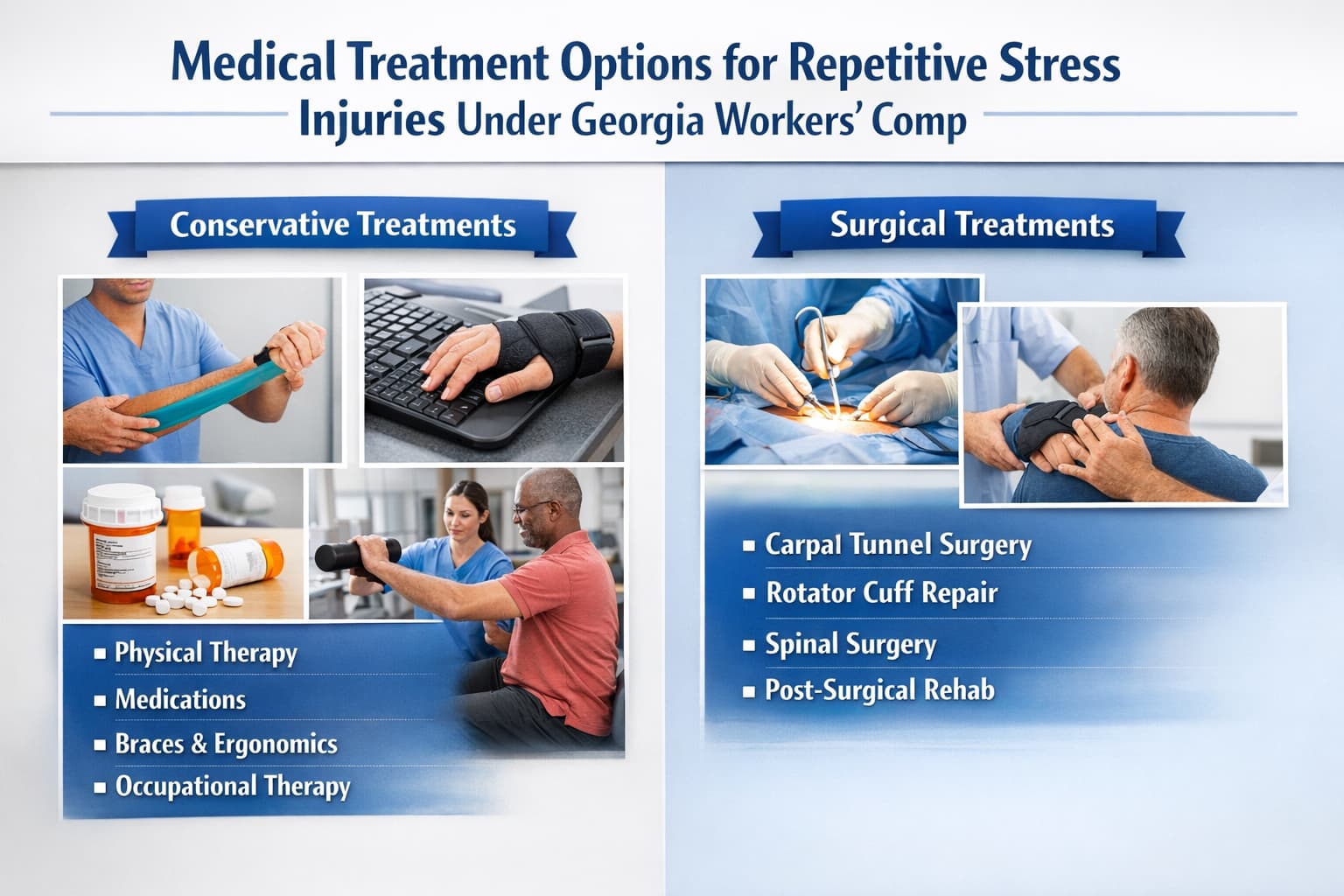
Repetitive stress injuries require comprehensive treatment addressing both damaged tissues and underlying biomechanical causes. Georgia workers’ compensation covers all reasonable and necessary medical care related to work injuries. Insurance companies often dispute treatment duration and modalities for these gradual onset conditions.
Conservative Treatment Covered by Workers’ Compensation
Initial treatment typically involves rest, anti-inflammatory medications, and physical therapy to reduce inflammation and restore function. Occupational therapy teaches modified techniques for daily activities while avoiding further trauma.
These conservative approaches succeed when implemented early before permanent damage occurs. Workers’ compensation is generally required to cover:
- Physical and occupational therapy sessions
- Prescription medications and injections
- Splints, braces, and ergonomic equipment
- Work restrictions and light duty assignments
- Diagnostic testing to monitor progress
Insurance companies frequently terminate benefits claiming maximum medical improvement despite ongoing symptoms and functional limitations requiring continued care.
When Surgery Becomes Necessary for Repetitive Injuries
Severe repetitive stress injuries may require surgery when conservative treatment fails. Carpal tunnel releases, rotator cuff repairs, and spinal decompressions restore function for many workers. Post-surgical rehabilitation often extends months with gradual return to modified duties.
Your Atlanta workers’ compensation lawyer can seek coverage for necessary surgery, second opinions, revision procedures, and rehabilitation when supported by medical necessity and authorization requirements. Insurance companies pushing quick returns to full duty risk re-injury and permanent disability.
Proper legal representation protects your right to full recovery before facing work demands that caused initial injuries.
FAQs for Atlanta Workers’ Compensation Lawyers
How do I prove my repetitive stress injury came from work and not aging?
Medical evidence distinguishing work-related trauma from age-related degeneration proves causation. Your doctor must explain how specific work activities accelerated or aggravated conditions beyond normal aging. Job analyses showing excessive repetitive forces support medical opinions about work causation.
What if I didn’t report my repetitive stress injury immediately when symptoms started?
Georgia law recognizes that repetitive stress injuries develop gradually, often without a clear reporting trigger. Report the issue as soon as possible, ideally within about 30 days of realizing it may be work-related, keeping in mind that timeliness is evaluated case by case under Georgia’s rules and exceptions. Be sure to document when medical providers first connected your condition to your job.
Can I get workers’ comp for carpal tunnel if I also use computers at home?
Georgia law requires work to be a substantial contributing factor, not the sole cause. Personal computer use doesn’t disqualify benefits if work activities significantly contributed to carpal tunnel development. Your Atlanta workers’ compensation lawyer presents evidence showing work demands exceeded personal use impacts.
Do repetitive stress injuries qualify for permanent disability benefits?
Yes. Repetitive stress injuries can qualify for permanent partial disability (PPD) benefits in Georgia when the authorized treating physician issues an impairment rating under the state’s statutory schedule. Workers may also receive temporary total disability (TTD) benefits if the injury prevents them from working or obtaining suitable employment, consistent with Georgia’s benefit limits.
What jobs have the highest risk for repetitive stress injuries in Georgia?
Manufacturing, healthcare, retail, and warehouse workers face highest risks in Georgia. Assembly line workers, nurses, cashiers, and order pickers develop these injuries most frequently. Office workers also suffer significant rates of carpal tunnel and neck injuries.
Take Action Now to Protect Your Rights After a Repetitive Stress Injury in Georgia
Repetitive stress injuries rob Georgia workers of careers and livelihoods while insurance companies pretend that gradual onset means non-compensable. These injuries result directly from workplace demands that push human bodies beyond their limits through countless repetitions. Your pain is real, your injury is work-related, and Georgia law provides benefits that insurance companies hope you won’t fight to receive.
Hasner Law stands ready to battle insurance companies that deny repetitive stress injury claims throughout Atlanta and Georgia. We build compelling cases proving work causation, document progressive symptoms, and secure medical treatment that restores function.
Our aggressive representation transforms denied claims into approved benefits that protect your financial future. Don’t let insurance companies dismiss your repetitive stress injury as normal aging or non-work activities.
Call Hasner Law at 678-888-HURT (4878) immediately for your free consultation with an Atlanta workers’ compensation lawyer who understands these complex claims.